Boards Over Basslines: Inside Britain’s Late-Night Chess Rooms
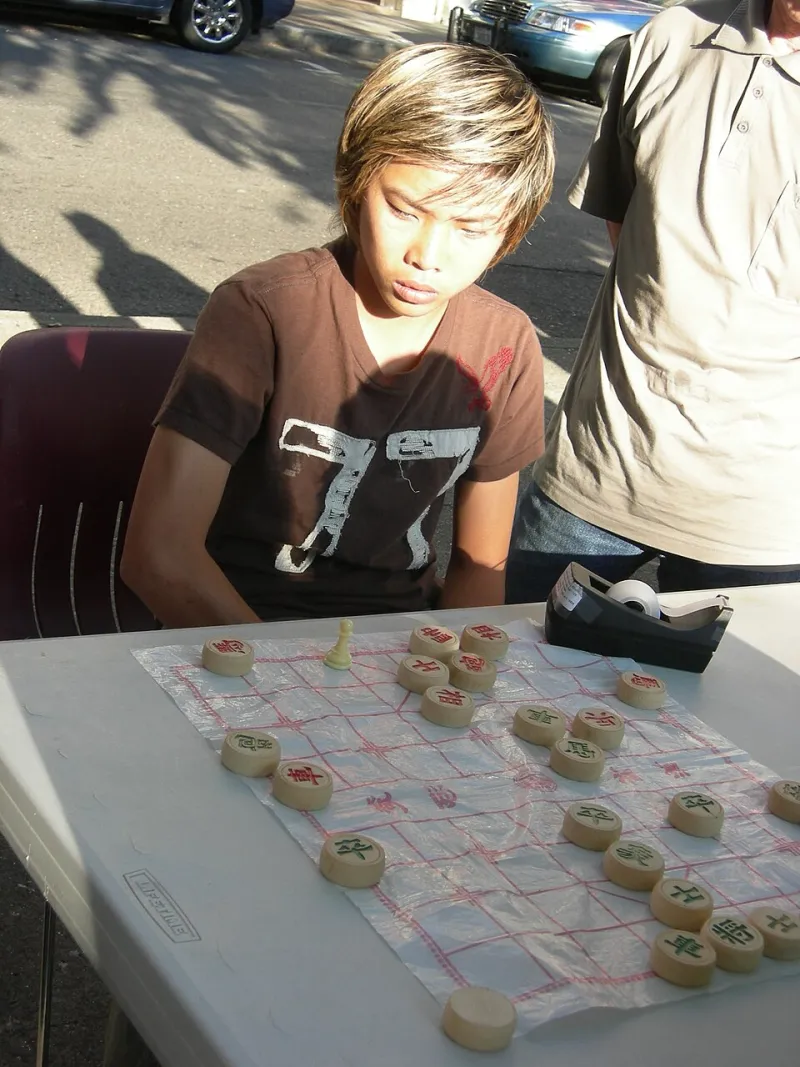
Photo: Joe Mabel, CC BY-SA 3.0, via Wikimedia Commons
It is 11.47pm on a Thursday in a basement off Kingsland Road, and the loudest thing in the room is a plastic chess clock. Two players are hunched over a board like they are defusing something. Around them, a hundred quiet things are happening: coats folded over chair backs, oat flat whites going cold, a queue for the next table, the low pulse of ambient records chosen so nobody has to shout. This is not a library. It is not quite a club. It is the after-hours chess café, and it is having a moment.
After Nyne has spent the past few weeks dropping into late-night chess nights in London, Manchester, Bristol and Glasgow. The details change — the lighting, the licences, whether there is a DJ or just a very careful Spotify queue — but the atmosphere is consistent. People arrive in good trainers and nice coats. They order something soft. They play fast, lose badly, laugh, reset the pieces. The night has the shape of a night out, but the volume has been turned down.
The quiet room with a pulse
The first thing to understand is that this is not a novelty night for people who hate fun. The chess is real. Blitz clocks tick down from five minutes. There are ladders, leagues, house rules about touch-move, and a quiet but unmistakable competitiveness that cuts through the room. At one Dalston event, a man in a corduroy jacket spent forty minutes waiting for a table, then lost in four minutes and immediately joined the queue again. He did not seem remotely put out. He seemed delighted.
The setting helps. Late-night chess cafés tend to borrow the visual language of the modern after-dark economy: low lamps, dark wood, plants that look expensive, a bar that can make you a proper drink but is just as happy to sell you a rhubarb soda. The music is ambient, dubby, sometimes gently cosmic. It gives the room a pulse without demanding anything from you. You can hear your opponent sigh. You can hear the clock. In a city that often treats silence as a problem to be solved with a bigger speaker, that feels quietly radical.
Why the dancefloor is sharing the night
The obvious read is that Britain has gone sober-curious and chess is the beneficiary. That is part of it. A night out that costs £6 on the door, £4 for a drink and nothing for the hangover is a persuasive proposition in 2026. But the appeal is not only abstention. It is participation. Dancing can be a wonderful way to disappear into a crowd; chess asks you to sit opposite one person and pay attention. For a certain kind of after-dark crowd — tired of shouting, tired of scrolling, not quite ready to go home — that is the draw.
There is also the spectator factor. Speed chess is good to watch. A blitz finish has the same compressed drama as a penalty shoot-out: sudden mistakes, sudden grace, the clock as villain. At a Bristol night in a café off Stokes Croft, a crowd of twenty gathered around a final board while a DJ played something humid and slow. Nobody danced. Everybody leaned in. When the losing king tipped over, the room made a sound somewhere between a gasp and a cheer. It was the most engaged I have seen a room of strangers in months.
From café table to club night
The format is still being figured out, which is part of the charm. In Manchester’s Northern Quarter, one café clears the cups at 10pm, unfolds the boards and runs a ladder until 1am. In Glasgow, a promoter has been trialling chess nights in a small venue with a bar, a DJ and a strict no-coaching rule. In London, the more established nights now have door policies, table waits and a quiet WhatsApp group for regulars. The etiquette is developing in real time: no trash talk during timed games, no hovering too close, no asking who is winning when the answer is obvious.
The club crossover is happening too. Chess corners are appearing at electronic music nights — not as a gimmick, but as a place to sit down without leaving the room. A deck of boards in the corner of a warehouse gives the night a different texture. It says: you can be here and not be on the dancefloor. You can have a conversation without competing with the kick drum. You can go back and forth between the two. The after-dark economy is getting better at offering options instead of a single script.
The economics of a silent crowd
For venues, the maths is more interesting than it looks. A chess night is cheaper to run than a headline DJ and kinder to neighbours. It sells drinks slowly but steadily. It builds a regular crowd who come back on a Tuesday. The main costs are chess sets, clocks and someone to run the ladder. The main risk is that the room gets too quiet and stops feeling like a night out. The best operators solve that with lighting, music and a little bit of theatre: a visible draw sheet, a proper clock, a table that feels like a stage.
There is a limit to how big this gets. Chess does not scale like a dancefloor. You need tables, space and a certain hush. But that may be the point. After years of nights getting bigger and louder, a room that asks you to lean in feels like a luxury. It is not anti-club. It is pro-choice. Britain’s after-dark tastes are widening, and chess is finding its place in the mix.
What the board says about Britain after dark
By 1.15am the basement is thinning out. The clocks are back in their box. Someone is putting a chess set away with the care of a person packing a suitcase. The last two players are still going, coats on, bags at their feet, neither willing to call it. Outside, the night bus is doing its rounds. Inside, the game is still the whole world.
That is the quiet promise of these rooms. They do not ask you to dance, drink or perform. They ask you to sit down, make a move and see what happens. In a country that has spent years rethinking what a night out can be, that is a surprisingly stylish proposition. The boards are out. The clock is ticking. Britain’s after-hours chess scene has found its move.