Dawn on the Lathe: The 4AM Ritual Keeping UK Club Music Physical
At 4am, most of Britain is making its mind up about a taxi. In a few small rooms off industrial estates, above chip shops and behind unmarked doors, the night is not over. It is being cut.
The scene is not glamorous. A lathe hums. A kettle clicks. Someone stands in a coat with a USB stick in one hand and a paper sleeve in the other. On the wall, there might be a poster for a night that finished three hours ago. On the desk, a lacquer disc waits to become a record that will never be pressed, never streamed, never sold. It will be played a handful of times, perhaps at a club the following weekend, perhaps only once. Then it will wear out. That is the point.
The room that hums
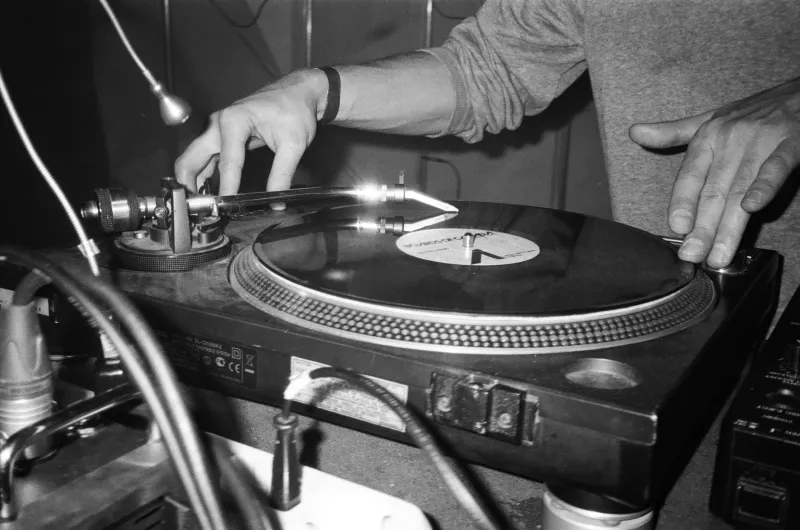
A dubplate is not quite a vinyl record in the way most people use the phrase. It is an acetate, cut in real time by a lathe, one disc at a time. There is no stamper, no pressing plant, no minimum order of 300. There is a cutter, a stylus, a track and a decision. The machine translates a digital file into a groove you can hold. The result is fragile, expensive and gloriously impractical.
That impracticality is why the 4AM cut has become its own ritual. In London, Bristol, Leeds, Manchester and Glasgow, small cutting rooms keep odd hours for DJs who finish their sets and do not want the night to end with a scroll through a folder. They arrive with edits, bootlegs, unfinished productions and secret weapons. They leave with an object that sounds different from the file. It has surface noise. It has weight. It has a label written in biro.
The cutter is part engineer, part therapist, part gatekeeper. They listen for the problem you did not know was there: a hi-hat too sharp, a bassline that will jump the needle, a vocal that needs a little more room. The best sessions are not transactions. They are conversations conducted at low volume, with one ear on the monitor and one on the door.
From USB to acetate
The dubplate has a long UK lineage. Soundsystem culture, jungle, garage, drum & bass and dubstep all understood the power of the exclusive. A plate that only you have is not just a track; it is a moment. In 2026, that logic has not disappeared. It has simply moved into smaller rooms and stranger hours.
What has changed is the speed and the spread. A DJ can finish an edit on a laptop in a hotel room, message a cutter, and collect an acetate before breakfast. The file is still fresh. The club is still ringing in their ears. The cut becomes part of the night’s residue, a physical footnote to a set that has already happened.
This is not nostalgia for its own sake. Many of the DJs using overnight lathes are young, digital-native and entirely comfortable with streaming. They are not rejecting the laptop. They are adding a step that the laptop cannot provide. The acetate cannot be sent as a link. It cannot be copied in a group chat. It cannot be played twice without leaving a mark. That scarcity is not a marketing strategy. It is physics.
A quiet afterparty
The afterparty has no DJ booth. It has a tone arm. The room is a decompression chamber for people whose ears are still working overtime. There is no queue, no cloakroom, no smoking area. There is a chair, a lamp and the sound of a groove being carved. The conversation is patchy. Someone talks about a club they miss. Someone else asks whether the kick is too loud. The cutter says nothing and adjusts something small.
Then comes the test play. The first revolution is always the most exposing. A track that sounded enormous through a club rig can suddenly seem thin, or busy, or strangely beautiful. The DJ leans in. The cutter leans back. For a few minutes, the music is not a performance. It is a piece of work being checked by two people who are both tired and both paying attention.
This is the part that does not translate to a screen. The dubplate is not just a format. It is a deadline. You have to decide. You have to commit. You have to leave with something that exists. In a culture where every set can be a playlist and every edit can be revised forever, that small act of finality feels almost radical.
The economics of scarcity
None of this is cheap. Acetates cost money. Lathe time costs money. The machines need care, the styli wear out, and the cutter’s evening is not free. A 4AM session is not a casual favour, even when it feels like one. It is a small piece of specialist infrastructure keeping a tactile corner of club culture alive.
That is why the overnight cut tends to attract people who are serious about what they do, even if what they do is gloriously silly. A DJ might spend more on a single acetate than on a month of streaming. They might play it twice and file it away. They might carry it to Berlin, Manchester or Belfast in a record bag that never leaves their side. The value is not in the unit cost. It is in the fact that the object did not exist before the night began.
The lathe operators know this. They also know the limits. An acetate is not a long-term archive. It wears. It hisses. It can be destroyed by a bad needle or a hot car. That fragility is part of the appeal, but it is also a warning. The 4AM cut is not a replacement for pressing records or releasing music. It is a complement: a quick, imperfect, human-scale gesture in a scene that often moves too fast to hold anything.
Dawn, sleeve, bus
By the time the record is sleeved, the sky is doing that grey-blue thing that makes every industrial estate look like the morning after a wedding. The DJ zips the acetate into a bag. The cutter starts cleaning up. The kettle goes on again. Outside, the first bus is not far away.
There is no grand statement here. No one is claiming the dubplate will save club culture. But the 4AM cut does something quietly useful. It slows the night down at the exact moment it would otherwise dissolve into a phone screen and a ride home. It gives the music a body. It gives the after-hours a room. And it gives the DJ one last thing to carry into the morning: a record that did not exist an hour ago, and might not exist for much longer.