Off the Rack, Into the Night: Britain’s After-Hours Vintage Economy
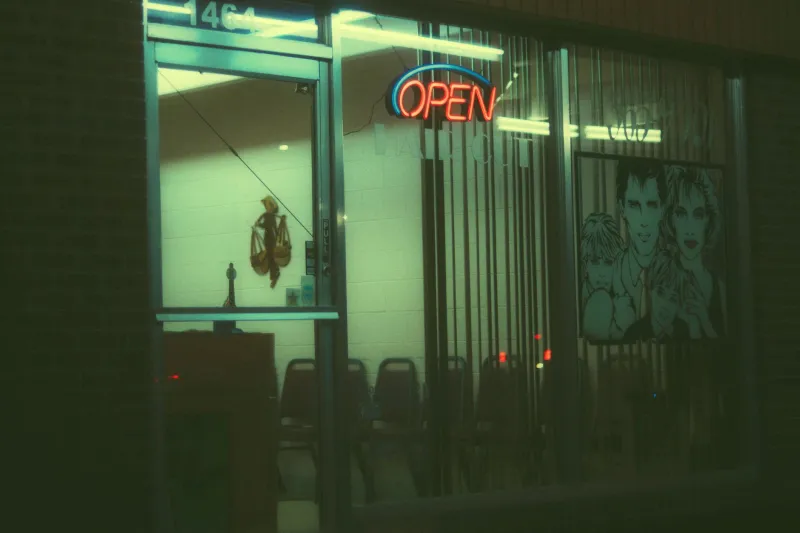
At 2.47am on a Saturday, the Northern Quarter is doing what it always does: emptying one set of doors and filling another. A club on Thomas Street is letting out a tide of coats; around the corner, a narrow vintage shop is still lit like a stage. The rail outside is mostly sequins and leather, the kind of thing that looks unreasonable until you see it under a streetlamp. Inside, three people are queuing for a fitting room no bigger than a phone box. One is holding a fake fur, one is holding a pint, and one is holding both.
This is the after-hours rail: part shop, part cloakroom, part confessional. Across London, Manchester, Bristol and Glasgow, late-opening vintage stores and rental rails are keeping clubland dressed long after the high street has pulled down its shutters. The transaction is simple — a jacket, a dress, a bag, sometimes just a belt — but the ritual is not. At 3am, trying something on becomes a social act: a second look, a second opinion, a small pause before the walk home or the next venue.
The shutters that stay up
Most of these places are not trying to be nightclubs. They are shops with extended hours, often Friday and Saturday only, sometimes Thursday if the diary looks good. In Shoreditch, a rental rail tucked behind a coffee counter opens at 10pm and runs until the first Tube. In Stokes Croft, a vintage unit stays open until 2am and charges £20 for a Saturday-night hire, deposit taken by phone. In Glasgow, a Southside shop has started a ‘late rail’ on Fridays: £15 for a frock, £25 for a suit, returns by noon Sunday.
The economics are modest but real. Late hours bring in people who would not normally browse vintage: clubbers, drag performers, birthday groups, people who have spilled something on a shirt and need a solution before the last train. Owners talk about ‘the 1am rush’ — not a crowd, more a trickle of determined shoppers who know exactly what they want. ‘They come in with a look in mind and a taxi waiting,’ says Mara Ellis, who runs a small vintage unit off Oldham Street in Manchester. ‘They are not here to browse. They are here to be fixed.’
That fix is often rental. The after-party wardrobe economy runs on clothes that are too good to own for one night and too specific to borrow from a friend. A rail of party pieces — metallic trousers, sheer shirts, cropped blazers — can turn over three or four times in a weekend. The shop makes its margin on repeat hires, not markups. The customer gets a look without the regret of buying it at 3am and finding it in a bag a week later.
The stylist on call
Between the shop and the club is a newer figure: the after-hours stylist. They work by DM, usually, and meet clients at doors, taxi ranks or pub corners. Some are attached to vintage shops; others are freelance, carrying a garment bag and a small kit of safety pins, hem tape and deodorant. They style for birthdays, drag nights, hen dos, last-minute dates and the occasional music video shoot that starts at midnight.
‘People don’t want a full makeover at 3am,’ says one stylist, who works between Leeds and Manchester and asks to be called Roo. ‘They want one thing that makes the outfit feel deliberate. A jacket. A chain. A different top. Something they can put on in a toilet and come out feeling like they have arrived.’
The stylist’s role is part practical, part emotional. They know which shop will still be open, which rail has the good leather, which fitting room has a mirror that flatters and a lock that works. They also know the etiquette of the late-night try-on: keep it quick, keep it kind, do not hog the mirror. At 3am, the fitting room is not a private cubicle so much as a small social stage. Friends wait outside. Strangers offer opinions. Someone always says ‘that’s very you’ and means it as a compliment, even when it is not entirely clear.
A different kind of door policy
The late-night shop has its own rhythm. Music is low — usually soul, sometimes dub, never anything that competes with the club next door. The lighting is warm. There is often a kettle, a bowl of something, a dog. The queue is not a queue in the usual retail sense; it is a loose gathering of people who are not quite ready to go home. They try things on, swap things, take photos in the mirror. Some buy. Some rent. Some just stand near the rail and talk.
For the shops, the challenges are practical. Licensing can be a grey area if they stay open past certain hours. Security is a consideration, especially if the door is propped open. Stock gets damaged — make-up on collars, spilled drinks, the occasional cigarette burn. Staff get tired. But the late hours also build loyalty. People come back in daylight to buy the thing they hired, or to return it and stay for a coffee. The 3am fitting room becomes a memory, and memories sell.
‘It is not a gimmick,’ Ellis says. ‘It is just retail at the time people actually want it. The high street decided everyone goes to bed at six. We didn’t.’
The morning after
By Sunday afternoon, the rails are thinner and the garment bags are back. Returns are checked, steamed, spot-cleaned and listed again. The after-hours economy leaves its traces in the till: a few hires, a few sales, a few numbers exchanged for next weekend. The clothes go back on the rail. The fitting room gets a sweep. The shop closes, or rather returns to its daytime self, quieter and less theatrical.
But the ritual lingers. Clubland has always been about transformation — the outfit, the make-up, the version of yourself that walks into the room. What is new is how late that transformation now happens. The 3AM fitting room is not just a place to change; it is a place to decide. And in a country where the high street shuts early and the night bus is unreliable, there is something quietly radical about a rail that stays open, a mirror that stays lit, and a shop assistant who says, with no irony at all, ‘Try the green one.’