Last Frame Standing: Inside Britain’s After-Hours Bowling Alleys
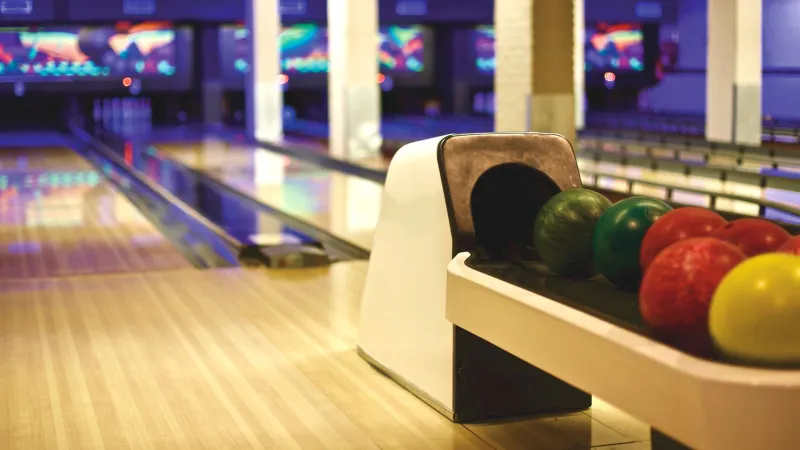
At 12.40am on a Thursday in Leeds, the loudest sound in the city centre is a pinsetter resetting itself. Clunk, whirr, clatter — a mechanical shrug that bounces off the far wall, crosses the carpet, and lands somewhere near the bar, where a man in rented shoes is eating chips from a paper cone with the concentration of a man defusing something.
Nobody is in a hurry. Lane four is empty and glowing. Lane five has two women in matching netball hoodies, one of whom has just thrown a gutter ball and is laughing so hard she has to sit down on the ball return. The screen above lane nine flickers a scorecard in a font nobody has updated since about 2004. And somewhere behind a curtain of neon, a DJ is playing a Sister Sledge record at a volume that suggests the neighbours have already been consulted.
This is the after-hours bowling alley, and it is having a moment.
The house lights go down
Somewhere between ten and eleven, the switch gets flipped. Not the main lights — those stay on in the toilet corridor and around the pin decks for obvious reasons — but the overheads drop to a low hum and the LED strips come up along the gutters, blue, pink, a slightly lawless green. The music changes. The bar menu shrinks to lager, espresso martinis and a bowl of something salty. And the crowd changes with it.
Early evening bowling is birthday parties and office socials and the particular panic of a parent watching a nine-year-old swing a 10lb ball like a hammer throw. Late bowling is something quieter and stranger: date nights on their third venue, groups of friends who have already failed to get into a club, night-shift workers arriving in the clothes they finished work in, and a hard core of regulars who genuinely care about their average.
“You get two completely different buildings,” says Marek, 34, who manages the night shift at a bowling venue in West Yorkshire and has the calm of a man who has seen everything a lane can throw at him, including a proposal. “Until ten it’s a family place. After ten it’s a room with a bar in it. The lanes don’t know it’s late. That’s the thing. The lanes behave exactly the same at two in the morning as they do at six at night.”
The prices reflect the shift, gently. A game that costs the best part of a tenner at peak often drops to six or seven quid after ten, sometimes with shoes thrown in, sometimes not. It is not quite the late-night happy hour of legend, but it is close enough that a group of four can bowl three games each and still be under the price of a round in some parts of London.
League night, just later
The real discovery of the late session is the league. Not the Thursday-night veterans’ league that has been running since the ten-pin boom of the 1960s, but the unofficial one: the midnight league, the Tuesday league, the league that exists mainly because the venue realised it had four empty lanes and a bar that was already open.
At one northern site, a Tuesday-night league runs from 11pm to 1am, four to a team, handicaps applied with great seriousness, team names printed on a laminated sheet behind the desk: Split Personalities. Gutter Mouths. Spare Me. “We’ve got a team of nurses from the hospital,” says the assistant manager, who asks not to be named because the league is technically oversubscribed. “They come in their scrubs. They’ve been on shift since seven in the morning and they still bowl better than half the lads who come in here.”
The appeal is not complicated. Bowling is one of the last public places in Britain where you are allowed to be visibly bad at something at one in the morning without anyone filming it. There is no dress code. There is no table minimum. You can be 58 or 19. The worst thing that can happen to you is a split, and the second worst is that somebody says “unlucky” in a tone that suggests it wasn’t.
The person behind the counter
Every after-hours venue lives or dies on its night staff, and bowling alleys are no exception. Marek’s evening involves three things in rotation: the bar, the till, and the pinsetter on lane two, which has a habit of jamming whenever the venue is at capacity. “It’s a beautiful machine,” he says, “and it is also a Rube Goldberg device with a hangover. When it stops, everything stops.”
He knows the regulars by their shoe size. He knows which group will ask for the bumpers ironically and then use them. He has, on more than one occasion, talked a crying stranger down from the top of the stairs by suggesting they throw one more game. “People come in here at midnight carrying a lot,” he says. “You give them shoes and a lane and for an hour they’ve got a job to do.”
The soundtrack is the whole trick
Every late-night bowling alley eventually arrives at the same problem: tempo. A dancefloor wants 120 beats per minute; a person holding a 14lb ball and trying to remember where their feet go does not. The best late rooms solve it by slowing everything down.
“You can’t play a build-up at somebody mid-approach,” says Priya, who runs a monthly vinyl night at a bowling venue in the Midlands. “It’s cruel. So I play disco, boogie, a bit of early house, 100 to 110. It’s music for walking, basically. You put on something with a big bassline and the whole room starts bowling in time. It’s the most satisfying thing I do all month.”
Some venues skip the DJ entirely and let a streaming playlist do the work — a decision that produces, predictably, the same eleven songs every week. But the ones that bother to program it properly have discovered something the clubs have spent thirty years monetising: a room where people sing along, spill a bit, and go home having actually done something.
The economics of the last frame
Late bowling is not a charity. Peak trade is still eight till eleven, and the late session runs on thin margins: thirty or forty people rather than two hundred. But the lights are already on, the rent is already paid, and the staff are already in the building. Every game sold after midnight is close to pure profit, which is why more venues are experimenting with it — later licences, quieter sound, food until 2am, cheap games after ten.
One manager puts it plainly: “The last hour is often the best hour we’ve got.”
Two o’clock, the shoe spray
By 2am the lanes are emptying out and the building is doing its quiet, unglamorous second act. The shoe spray comes out. The ball returns get wiped down. Somebody mops the bit of floor where a pint went over near lane seven. The last group — three of them, still in coats — are finishing a sixth game they didn’t plan to play.
They pay, hand back their shoes, and step out onto a street that has gone completely silent. The pinsetter clunks one final time behind them and then stops. Somewhere a taxi rank glows. And for a couple of hours, in a room that smells faintly of banana oil and disinfectant, the night had one more frame in it.