A Small Light in the Shutter: Britain’s 3AM Hatches Are Still Open for Business
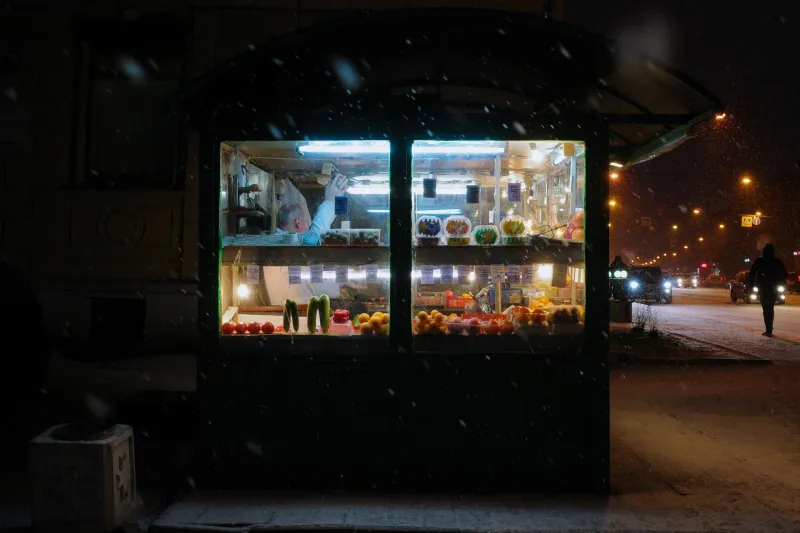
At 2:57am, the high street looks like it has been packed away. Shutters down, bins out, a stray chip box turning slow circles in the gutter. Then you see it: a rectangle of light at ankle height, or a hatch slid back six inches, or a grille with a hand appearing underneath it like a magician’s trick. Britain after midnight is not always closed. Sometimes it is just serving through a smaller window.
The all-night kiosk hatch is one of the great unglamorous bits of British night-time infrastructure. It is not a bar, not a club, not a taxi rank. It is a newsagent’s side window in Sheffield, a kebab shop’s serving hatch in South London, a corner shop grille in Cardiff where the fags are passed through a gap the width of a paperback. It is where cash, cigarettes, phone credit, paracetamol, a lighter, a Lucozade and sometimes a full conversation change hands at an hour when most of the country is asleep.
The Window That Outlasts the Shop
“The shop shuts at eleven,” says Reena, 41, who runs a family newsagent in Manchester’s Northern Quarter. “But the hatch stays open till four, sometimes five. People don’t need the shop. They need the window.”
Reena’s hatch is a modest thing: a sliding pane above the counter, a shelf worn smooth by elbows, a strip light that gives everyone the complexion of a witness in a police drama. Around it, the street is all closed doors and wet pavements. Through it, the night gets a little more manageable. A taxi driver buys mints and a phone charger. A nurse coming off shift asks for the cheapest coffee and a lighter she will lose by Thursday. A man in a suit, tie loosened, buys nothing at first, then a packet of cigarettes, then stands under the awning and tells Reena about his brother.
“You get the same faces,” she says. “They don’t always buy much. But they know the light is on. That’s the thing. The light is on.”
That is the hatch’s real function. It is not just retail. It is a signal. The high street may be shuttered, but it is not entirely dead. Somewhere, a small window is still doing business.
Cash, Credit and a Lighter
The economics of the hatch are beautifully simple. Low overheads, high loyalty, a captive market of people who are either going home, going to work, or not quite ready to go either. The stock is not curated; it is accumulated. Rolling tobacco, vapes, phone top-ups, chocolate, condoms, dental floss, a single AAA battery, a fork. The hatch does not judge. It serves.
Danny, 29, works the side window of a kebab shop in south-east London. The main shop closes at 1am; the hatch stays open until 4am, sometimes later on Fridays. “We do wraps, chips, cans, cigarettes,” he says. “But mostly we do directions. People ask where the night bus is. They ask if the chicken shop over the road is open. They ask if I know their mate. I don’t know their mate.”
He laughs. “But I know the bus. I know the bus is not coming for twenty minutes. So they stand there and eat chips and I stand here and we both wait.”
This is the hatch as a kind of open-air lobby. It is not warm, exactly. It is not comfortable. But it is a place to pause. The grille is a boundary, but it is also a counter. The transaction is small, but the exchange is bigger. In a city that can feel brutally indifferent after midnight, a hatch is a face.
The Regulars Who Know the Hatch by Name
There are regulars who treat hatches like pubs. They know the opening times, the staff rotas, the exact angle at which to stand so the rain does not get in. They know which hatch will break a tenner and which one will not. They know the difference between a grille that is closed for the night and one that is closed for a break.
“I come here most nights,” says Tom, 34, a delivery rider in Birmingham. “Not always to buy. Sometimes just to say hello. It’s the only place open. You can’t stand outside a bank at three in the morning. You can stand outside a hatch.”
Tom buys a can of Coke and a packet of crisps. He does not open either. He puts them in his bag and gets back on his bike. The hatch slides shut, then opens again as another figure approaches. The light stays on.
Why the Hatch Is Closing
But the hatch is disappearing. Not everywhere, not all at once, but steadily. Councils are tightening late-night licensing. Landlords are raising rents. Contactless payment is making cash-only hatches look archaic. Delivery apps have taught people that anything can arrive at the door, so why walk to a window? And the big chains, when they bother to open late, prefer the bright, anonymous theatre of a self-service checkout to the awkward intimacy of a human being passing you a lighter through a gap.
The hatches that remain are often family-run, cash-friendly, and stubborn. They are not nostalgic. They are practical. Reena does not romanticise her window. “It pays the bills,” she says. “It pays a bit more than the shop, some nights. But it’s hard. You’re on your own. You have to be careful who you let stand there.”
She pauses. “But I’d miss it. The quiet ones. The ones who just want a chat. You don’t get that in the day. In the day, everyone is in a rush.”
What the Hatch Knows
At 3:40am, the hatch is still doing business. A woman in scrubs buys a KitKat and a bottle of water. A man with a guitar case asks for directions to a street that does not exist. A teenager buys a lighter and tries to look older than he is. The shutters are down all along the street. The hatch is not. It is a small, lit rectangle in a dark wall, and it is enough.
Britain’s night-time economy is often talked about in terms of big numbers: footfall, spend, licensing hours. But the hatch operates on a smaller scale. It is a window, a shelf, a hand. It is the last shop on the way home. It is the first sign that the city is not entirely asleep. It is a bit of infrastructure that no one planned and no one celebrates, and it is quietly disappearing.
If you find yourself on a UK high street at 3am, look for the light. It won’t be on for much longer.